Posts

Showing posts with the label bioinformatics

fileindex

Disclaimer: This is about a generic indexing method that fits in here and explained below. Everyone's indexing big sequence files. Peter Cock has a bio-python branch to index via sqlite. Brad Chapman writes up a nice approach using tools from bx-python . And there's my own pyfasta for fasta files. This morning I set out to use another one: screed from the pygr guys to index fastq and fasta files via sqlite db. Titus wrote about screed and posted to the biology-in-python mailng list, which is how i originally heard about it. Screed and the biopython branch use sqlite to get quickly from name to thing--random access. This is a nice approach because sqlite comes with python and it's easy to use and quite fast. Thinking simply about an index, all it really does is get you from some id (e.g. a fasta header or fastq name) to the thing (the fasta sequence or the fastq record). In the case of flat files, it's a mapping from and id or name to the fseek file-position at ...

Loopless programming (for calculating methylation types)

DNA Methylation is used in plants as a means of epi-genetic regulation. Bi-sulfite sequencing is a method used to determine the methylation pattern of a given set of DNA. Methylation occurs at 'C'ytosines. In plants, there are 3 types of methylation , determined by the nucleotides that follow the 'C': CG: a 'G' follows the 'C' CHG: anything but a 'G' follows the 'C' and a 'G' follows that CHH: no 'G' in the 2 subsequent nucleotides. So, programmatically, it's a trivial matter to calculate the type of methylation that can occur at each cytosine in a given sequence. Though, once the edges and edge-cases and reverse-complement are handled, it becomes a few lines of code full of loops and if's. For python (and most scripting languages) that's slow and loopy and iffy. The rest of this code explains how I utilized numpy to make a fast methylation-type calculator without loops or ifs. Loopless Given a nump...

needleman-wunsch global sequence alignment -- updates and optimizations to nwalign

I've written previously about nwalign , a python package I wrote to do fast (thanks to cython) global sequence alignment. Over break, I spent some time fixing some bugs and improving performance. Ack It's actually nice to get bug reports for a relatively obscure bit of software like this as it shows it's getting used. Thanks especially to R. Christen for his patience in (repeatedly) showing me places where nwalign was not doing the right thing. Bugs Placement of Gaps Some of the "Bugs" were actually just "unspecified behavior". For example, given input text of "AGEBAMAM" and "AGEBAM", the alignments: AGEBAMAM AGEBAM-- and AGEBAMAM AGEB--AM Have the same score. However, the first version is generally more, um, polite. Previously, the behavior was deterministic, but depended on the length and order of the input sequence. As of version 0.3, nwalign will always put matches together when given a choice between 2 (or more) paths through t...

Needleman-Wunsch global sequence alignment

[EDIT 01-01-2010] this is now available at bitbucket . I've written a simple, fast, python version of Needleman-Wunsch as I couldn't find one to use. It uses Cython and specifically cython-numpy goodness. It's easy-installable as: sudo easy_install -UZ http://bpbio.googlecode.com/svn/trunk/nwalign/ or via svn from: svn co http://bpbio.googlecode.com/svn/trunk/nwalign/ it will put an executable 'nwalign' into /usr/bin/ which when run will give this message: Usage: nwalign [options] seq1 seq2 Options: -h, --help show this help message and exit --gap=GAP gap extend penalty (must be integer --gap_init=GAP_INIT gap start penalty (must be integer --match=MATCH match score (must be integer > 0) --mismatch=MISMATCH gap penalty (must be integer --matrix=MATRIX scoring matrix in ncbi/data/ format, if not specificied, match/mismatch are used where the matrix is optional but can be the full path ...

biohash

This is a quick project I did a while back but, I've seen people interested in similar ideas, so I'll post my implementation here. Geohash encodes latitude/longtitude locations into a string such that "nearby places will often present similar prefixes" and the longer the string, the greater the precision. Using this python implementation by Schuyler as a reference, I ported the concept to a "biohash" which can encode intervals. It works in a similar fashion, starting with the extremes and halving the space until it finds the smallest space that contains the interval. The use to allow efficient search of intervals using a BTree index, as in any relational db. It's implemented with only a dumps() and loads() function after the pickle interface. The dumps function takes start and end args and returns a 1/0 encoded string. The loads takes a 1/0 encoded string and returns the tightest interval it can given that string. Both functions take a rng kwarg, whic...

Stupid things I did as a Bioinformatics Programmer in 2008

In 2008, I was good enough at programming to get my ass kicked by hard problems. I think that's the most positive way to say it. My main bioinformatics project was a long annotation pipeline. It takes days to run, often using 8 CPUs. It's driven by a big ol' Makefile. I made the mistake of passing data between steps in un-structured text files or python pickles. I'd create one at the beginning of the pipeline and not notice it was messed up in a way that affected other parts until the entire pipeline was done, days later. Toward the end of the pipeline, I'd need something simple, like the strand of a BLAST hit, but I'd have to parse through an entire GFF file, or load some huge pickle into memory just to get to that. Then I'd need some annotation, and I'd have to add a slow step of doing a lookup in a script that'd otherwise run very quickly. I was passing around data in arrays and tuples, so then when I changed the order or added another element in...

openlayers, genomes and image-maps

In response to Titus' post on using imagemaps for genomic visualization: Why are imagemaps so popular in genomics? As an extreme and unfair comparison, just imagine if http://maps.google.com was an image map. Given a CGI script that can accept a url like &start=1024&stop=2048&chr=3 and return an appropriate image, you can provide a substantial set of tools using openlayers , which is developed by what must be one of the largest and active developer communities in GIS. (Yes, I am an openlayers fan-boy.) You can do that with a small addition to openlayers which I updated a couple weeks ago to OL version 2.6. In that update, I removed > 140 lines of code . So, it's now even less of a change to OL. Maybe when 2.7 comes out, I'll figure out how to provide a patch that allows an extra argument to the OpenLayers.Map constructor that limits panning to the horizontal direction -- in which case genome-browser will cease to exist and only the single file containing ...

synteny mapping

Image
Living in Synteny I've been working on automating synteny mapping between any pairs of genomes. Synteny is where there's a stretch of DNA or genes in some order on chromosomeA of organismX and due to a shared evolutionary history, you can find a similar stretch of genes in order on chromosomeB of organismY. Often there are small losses and inversions, but between closely related organisms like man and mouse , there's still a lot of synteny. Plants can undergo polyploidy , following which, a species can have 2 entire copies of its genome. Over time, much of the duplicated cruft is lost, and the homologous chromosomes diverge, but if the divergence is not too great, it's still possible (actually common) to find synteny within the genome of a single organism--as well as between organisms. I've written my own algorithm to find synteny which uses python sets, and numpy array slicing to do the heavy lifting. It is quite clever [wink]. And it _almost_ works but it'...

fast python with shedskin

There's a new release of the shedskin compiler. It is able to generate fast shared libraries that can be run from CPython. It can also create binaries so I thought I'd see how it did on some code from this BMC bioinformatcs article compared to psyco and CPython. I took this iterative, brute-force ( Needleman-Wunsch ?) alignment code and modified it slightly. That's pasted here . (Notice the first line! that's how it appears in the original code). The modifications allow shedskin to infer the function and variable types. Plus, there's a couple changes I made that improve the run-time for all cases. The max() function is also in the original, but unnecessary because of python's builtin max(), however, pysco does run much faster using their hand-coded max(). For the shedskin run, I removed that extra code and used shedskin's builtin 'cause it made me feel better. The python code was run as $ time python -c "import alignment; alignment.imain()"...

python bioinformatics

There's a new article out in BMC Bioinformatics with a comparison of the speed and length of programs from various languages. This article was sent to the biology in python ( BIP ) mailing list. Looking at the code, it's not that bad, but it is clear that the authors are not pythonistas, and that the reviewers have done a great job on the actual paper, but likely there was no thorough review of the code. The authors define their own max() function that needlessly overrides python's built-in, and they use the code: line.rstrip('/n') that indicates there was not a thorough understanding of python, or a complete code review. Even a non-python programmer should have seen the intent was to strip a newline '\n', but the operation is not inplace, so the desired behavior could be achieved by: line = line.rstrip('\n') Syntactical mistakes aside, python was given a poor review on speed. Andrew Dalke, of wide-finder (and general python-bio) fame ran the alig...

parallel blasts using python's pp module

Image
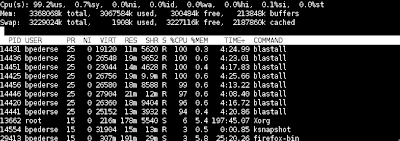
BLAST handles utilizes multiple cores for some scenarios using the -a flag. however, i often do full genome blasts -- blasting all chromosomes of one organism against all others. For the case of rice (O.s.) against itself, this is 124 jobs. there are simple tools in python to run a queued blast in which on my 8 core machine, each core will run 1 of those blasts, as a job finishes, the pp or parallel python module starts the next job, based on the number of cpus it has detected for your machine. the syntax for the script is: python pblast.py rice_rice_10kmers where rice_rice_10kmers is the section in a config/.ini file to get the parameters. My fasta directory looks like: $ ls /tmp/rice/fasta/ ricetenkmers_chr01.fasta ricetenkmers_chr04.fasta ricetenkmers_chr07.fasta ricetenkmers_chr10.fasta ricetenkmers.order ricetenkmers_chr02.fasta ricetenkmers_chr05.fasta ricetenkmers_chr08.fasta ricetenkmers_chr11.fasta ricetenkmers_chr03.fasta ricetenkmers_chr06.fasta ricetenkmers_chr...