Posts

Showing posts with the label ngs

(bloom) filter-ing repeated reads

In this post, I'll talk a bit about using a bloom filter as a pre- filter for large amounts of data, specifically some next-gen sequencing reads. Bloom Filters A Bloom Filter is a memory efficient way of determining if an element is in a set. It can have false positives, but not false negatives. A while ago, I wrote a Cython/Python wrapper for the C code that powers the perl module, Bloom::Filter . It's has a nice API and seems very fast. It allows specifying the false positive rate. As with any bloom-filter there's a tradeoff between the amount of memory used and the expected number of false positives. The code for that wrapper is in my github, here . Big Data It's a common request to filter out repeated reads from next-gen sequencing data. Just see this question on biostar. My answer , and every answer in that thread, uses a tool that must read all the sequences into memory. This is an easy problem to solve in any language, just read the records into a dict/ha...
filtering paired end reads (high throughput sequencing)

NOTE: I don't recommend using this code. It is not supported and currently does not work for some sets of reads. If you use it, be prepared to fix it. I wrote last time about a pipeline for high-throughput sequence data. In it, I mentioned that the fastx toolkit works well for filtering but does not handle paired end reads. The problem is that you can filter each end (file) of reads independently, but most aligners expect that the nth record in file 1 will be the pair of the nth record in file 2. That may not be the case if one end of the pair is completely removed while the other remains. At the end of this post is the code for a simple python script that clips an adaptor sequences and trims low-quality bases from paired end reads. It simply calls fastx toolkit (which is assumed to be on your path). It uses fastx_clipper if an adaptor sequence is specified and then pipes the output to fastq_quality_trimmer for each file then loops through the filtered output and keeps onl...

ngs / high-throughput sequencing pipeline

Image
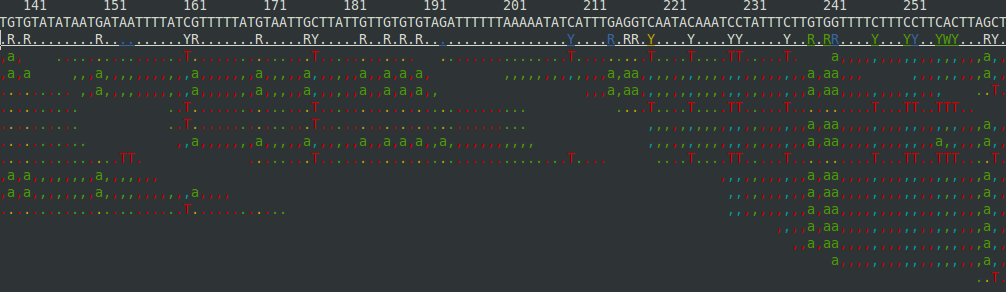
This is the minimal set of preprocessing steps I run on high-throughput sequencing data (mostly from the Illumina sequencers) and then how I prep and view the alignments. If there's something I should add or consider, please let me know. I'll put it in the form of a shell script that assumes you've got this software installed. I'll also assume your data is in the FASTQ format . If it's in illumina's qseq format, you can convert to FastQ with this script by sending a list of qseq files as the command-line arguments. If your data is in color-space, you can just tell bowtie that's the case, but the FASTX stuff below will not apply. This post will assume we're aligning genomic reads to a reference genome. I may cover bisulfite treated reads and RNA-Seq later, but the initial filtering and visualization will be the same. I also assume you're on *Nix or Mac. Setup The programs and files will be declared as follows. #programs fastqc=/usr/local/src/...