Posts

What a Shapely genome you have!
Image
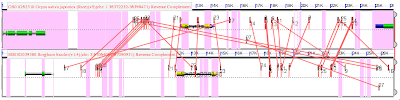
This might be a case of if you have a really cool hammer , everything looks like a nail, but it was fun mixing tools from different disciplines. After finding synteny , there's a bunch of paired genes whose neighbors are also pairs. Paired ( homologous ) genes have similar sequence because they have some function and can't change without loss of function. Non-gene sequence between the paired genes is mostly randomized via mutation, deletion, etc. But, there is non-gene sequence that is conserved between the genes. These CNS's-- conserved non-coding sequences--are usually sites that bind stuff that regulates the expression of a gene. That looks like this. With one gene on the top, and its pair below, both yellow. Pink lines in the foreground connect putative CNSs (similar sequences) between these genes. That the lines cross is bad. CNSs occur right at the level of noise. So even though a similar sequence occurs near both genes, it could be by chance. It is possible to red...

flash, vi, fcsh

All my flash tinkering has been in VIM-- no IDE, no XML, just actionscript. It's a little tough to deal with the adobe compiler as it takes about 11 seconds to compile a large project like modestmaps on my machine. That's not good for a guess-and-check programmer. The typing does catch some errors. The worldkit project compiles instantaneously with mtasc (the predecessor to haxe )--likewise for the as2 branch of modestmaps. The flash compiler shell drops the compile time for as3 modestmaps to under 3 seconds, so I've added this to my .bash_aliases: alias fcsh="/usr/bin/rlwrap /opt/src/flex2/bin/fcsh" the rlwrap is to use readline in the flash shell--meaning I can just press up-arrow to get the previous compile command. By default, one has to paste or type the entire command again. With that, it's close to a reasonable workflow.

synteny mapping

Image
Living in Synteny I've been working on automating synteny mapping between any pairs of genomes. Synteny is where there's a stretch of DNA or genes in some order on chromosomeA of organismX and due to a shared evolutionary history, you can find a similar stretch of genes in order on chromosomeB of organismY. Often there are small losses and inversions, but between closely related organisms like man and mouse , there's still a lot of synteny. Plants can undergo polyploidy , following which, a species can have 2 entire copies of its genome. Over time, much of the duplicated cruft is lost, and the homologous chromosomes diverge, but if the divergence is not too great, it's still possible (actually common) to find synteny within the genome of a single organism--as well as between organisms. I've written my own algorithm to find synteny which uses python sets, and numpy array slicing to do the heavy lifting. It is quite clever [wink]. And it _almost_ works but it'...

open source gis and flash maps part two

Mash Flap I started looking into flash mapping stuff lately. For the patch I submitted to worldkit, Mikel gave me commit access! So, now the svn version of worldkit can be compiled with mtasc by typing "make". I feel unreasonably proud of that, given that much of what I did was some global search and replace stuff in VI, and then read and fixed mtasc compiler errors until they went away. It was good fun. Michal Migurski saw in that same post that I mentioned modestmaps and gave me some good ideas on getting WMS going. I just figured out how to get that working and posted a message to their overly web2.0 forums. Hopefully someone with some real actionscript skillz will clean it up. A mapping library without a good WMS interface is much less useful for most of the stuff I do. I haven't decided whether to use modestmaps or worldkit, or both. The time stuff the Mikel has done in worldkit is very cool and I haven't really looked at that yet. But I have a tim...

fast python with shedskin

There's a new release of the shedskin compiler. It is able to generate fast shared libraries that can be run from CPython. It can also create binaries so I thought I'd see how it did on some code from this BMC bioinformatcs article compared to psyco and CPython. I took this iterative, brute-force ( Needleman-Wunsch ?) alignment code and modified it slightly. That's pasted here . (Notice the first line! that's how it appears in the original code). The modifications allow shedskin to infer the function and variable types. Plus, there's a couple changes I made that improve the run-time for all cases. The max() function is also in the original, but unnecessary because of python's builtin max(), however, pysco does run much faster using their hand-coded max(). For the shedskin run, I removed that extra code and used shedskin's builtin 'cause it made me feel better. The python code was run as $ time python -c "import alignment; alignment.imain()"...

Python Mapscript Tricks

Image
I mentioned previously a site which uses google maps with a WMS. The problem with using points (or labels) in a tiled application such as google maps, or OpenLayers is that each tile can only draw its own contents. So if you draw a point with a radius of 10 pixels whose center is 2 px away from the edge of the tile, then 8px of the entire 20px will be chopped. By default, those lost 8 pixels will not be drawn in the adjacent tile because the center of the point does not fall in that tile. so that gives something that looks like this for 2 adjacent tiles: It's hard to even tell that those tiles belong together! Using some python mapscript and PIL , it's pretty simple to make those look like this( except I dont know how to tell blogger not to add the spacin...) : That's actually the same WMS request(s), just changing the call from a simple WMS CGI script that calls mapserver to a WSGI script that uses python mapscript and PIL. The script: 1. takes the current bounding bo...

Open Source GIS

Just saw this linked from Sean's post . The quotes in there are absurd. But reminded me there's an important point in favor of OSS that I haven't seen. You can still get help directly via the email list or IRC from F Warmerdam , it's primary author. Likewise for the developers of Mapserver and OpenLayers and PostGIS . I wonder if the lead developers of ESRI products spend their off-time perusing the forum's or mailing lists and answering questions? ( I don't know, they may. But I suspect not. ) There's something to be said for enjoying what you do. And I think that's very true in the case of those in the open-source community. Happy coders make better software. Any programmer that denies that will leave me flabbergasted. I just don't understand how I could be effective only clicking the menus that were provided to me if I chose a black-box solution. But, call me crazy, I like linux. Also, in these parts, if you lock your single-speed bike to a woo...

Flash-y Map-plication vs. 500 marker limit

Image
I've been pushing capabilities of javascript mapping frameworks. There's a real limit on the number of markers a browser can display without getting bogged down. 500 is a good limit, and that's probably too high for internet explorer. You can put as many markers as you like via WMS tiles. You can even take map clicks, send them back as AJAX queries and open an info window. I recently helped my friend do this, and we have a pretty snappy map displaying 5,000+ clickable "markers" no problem. It's actually not markers, just tiles, but it works quite well: That's a snapshot of the google maps application, with an info window that appears when a marker is clicked. It sends a GetFeatureInfo request back to a mapserver WMS. Vector drawing in the browser is limited. The amazing efforts of the OpenLayers , featureserver projects make this difficult to assert, as they abstract away all of the browser incompatibilities and give a nice platform to do real vector edit...

python bioinformatics

There's a new article out in BMC Bioinformatics with a comparison of the speed and length of programs from various languages. This article was sent to the biology in python ( BIP ) mailing list. Looking at the code, it's not that bad, but it is clear that the authors are not pythonistas, and that the reviewers have done a great job on the actual paper, but likely there was no thorough review of the code. The authors define their own max() function that needlessly overrides python's built-in, and they use the code: line.rstrip('/n') that indicates there was not a thorough understanding of python, or a complete code review. Even a non-python programmer should have seen the intent was to strip a newline '\n', but the operation is not inplace, so the desired behavior could be achieved by: line = line.rstrip('\n') Syntactical mistakes aside, python was given a poor review on speed. Andrew Dalke, of wide-finder (and general python-bio) fame ran the alig...

parallel blasts using python's pp module

Image
BLAST handles utilizes multiple cores for some scenarios using the -a flag. however, i often do full genome blasts -- blasting all chromosomes of one organism against all others. For the case of rice (O.s.) against itself, this is 124 jobs. there are simple tools in python to run a queued blast in which on my 8 core machine, each core will run 1 of those blasts, as a job finishes, the pp or parallel python module starts the next job, based on the number of cpus it has detected for your machine. the syntax for the script is: python pblast.py rice_rice_10kmers where rice_rice_10kmers is the section in a config/.ini file to get the parameters. My fasta directory looks like: $ ls /tmp/rice/fasta/ ricetenkmers_chr01.fasta ricetenkmers_chr04.fasta ricetenkmers_chr07.fasta ricetenkmers_chr10.fasta ricetenkmers.order ricetenkmers_chr02.fasta ricetenkmers_chr05.fasta ricetenkmers_chr08.fasta ricetenkmers_chr11.fasta ricetenkmers_chr03.fasta ricetenkmers_chr06.fasta ricetenkmers_chr...

tinycc

i've been _trying_ to learn C. tinycc, beside being tiny, it compiles very quickly, allowing you to do cool things like script in C #!/usr/bin/tcc -run #include int main(int argc, char *argv[]) { printf("Hello World %s, %s", argv[0], argv[1]); return 0; } and then run as ./file.c arg_1 which makes it easier for those c-fu to guess and check. it also allows such nice things as c in python which is like pyinline, but uses ctypes and doesn't need write access.

Sorting by proximity to a date in PostgreSQL

postgreSQL has great support for dates, => SELECT '2007-08-23'::date - '2006-09-14'::date as days; days ------ 343 given a date column and a date, to find the nearest date, you can "extract the epoch", here, i used ABS as i just want the nearest date, before or after. SELECT *, ABS(EXTRACT(EPOCH FROM(date - '2006-08-23'))::BIGINT) as date_order FROM record WHERE well_id = 1234 ORDER BY date_order limit 1 i suppose this could make a nice PL/PGSQL function...

k-means clustering in scipy

it's fairly simple to do clustering of points with similar z-values in scipy: import numpy import matplotlib matplotlib.use('Agg') from scipy.cluster.vq import * import pylab pylab.close() # generate some random xy points and # give them some striation so there will be "real" groups. xy = numpy.random.rand(30,2) xy[3:8,1] -= .9 xy[22:28,1] += .9 # make some z vlues z = numpy.sin(xy[:,1]-0.2*xy[:,1]) # whiten them z = whiten(z) # let scipy do its magic (k==3 groups) res, idx = kmeans2(numpy.array(zip(xy[:,0],xy[:,1],z)),3) # convert groups to rbg 3-tuples. colors = ([([0,0,0],[1,0,0],[0,0,1])[i] for i in idx]) # show sizes and colors. each color belongs in diff cluster. pylab.scatter(xy[:,0],xy[:,1],s=20*z+9, c=colors) pylab.savefig('/var/www/tmp/clust.png')

using python mapscript to create a shapefile and dbf

i always have trouble remembering how to use mapscript. it's pretty simple, but the docs are hard to find and the test cases (though excellent!) have a lot of abstraction. heres some code that creates a shapefile and dbf (using another module). and does a quick projection at the start. import mapscript as M import random from dbfpy import dbf ######################################### # do some projection ######################################### p = 'POINT(466666 466000)' shape = M.shapeObj.fromWKT(p) projInObj = M.projectionObj("init=epsg:32619") projOutObj = M.projectionObj("init=epsg:4326") shape.project(projInObj, projOutObj) print shape.toWKT() ######################################### # create a shapefile from scractch ######################################### ms_dbf = dbf.Dbf("/tmp/t.dbf", new=True) ms_dbf.addField(('some_field', "C", 10)) ms_shapefile = M.shapefileObj('/tmp/t.shp', M.MS_SHAPEFILE_POLYGON) for ...

Note to self: using python logging module

import logging logging.basicConfig(level=logging.DEBUG ,format='%(asctime)s [[%(levelname)s]] %(message)s' ,datefmt='%d %b %y %H:%M' ,filename='/tmp/app.log' ,filemode='a') logging.debug('A debug message') logging.info('Some information') logging.warning('A shot across the bows')

Fix indentation in VIM

Often times, i get which has the indentation completely messed up, not just mixing tab/spaces, but really "whack" these commands seem to magically fix for at least 2 test cases: :set filetype=xml :filetype indent on :e gg=G

Using Python MiddleWare

just trying to figure this stuff out. it's pretty simple, but there's one level of abstraction through web.py. you can use middleware to add keys to the environ for example. http://groovie.org/files/WSGI_Presentation.pdf #!/usr/bin/python import web import random class hi(object): def GET(self,who='world'): web.header('Content-type','text/html') print "hello %s" % who class bye(object): def GET(self,who='world'): web.header('Content-type','text/plain') print "bye %s" % who for c in web.ctx.env: print c, web.ctx.env[c] class other(object): def GET(self): web.header('Content-type','text/plain') for c in web.ctx: print c, web.ctx[c] urls = ( '/bye/(.*)', 'bye' ,'/hi/(.*)' , 'hi' , '/.*' , 'other') class RandomWare(object): def __init__(self, app): ...

Install run, and benchmark mod_wsgi in < 10 minutes

svn checkout http://modwsgi.googlecode.com/svn/trunk/ modwsgi cd mod_wsgi ./configure make sudo make install # note where mod_wsgi.so went on your system echo "LoadModule wsgi_module /path/to/mod_wsgi.so" >> /path/to/apache2.conf mkdir /var/www/wsgitest/ cd /var/www/wsgitest/ vi .htaccess # [in .htaccess] Options +ExecCGI < Files hi.py > SetHandler wsgi-script </Files> # [ end .htaccess] vi hi.py # [in hi.py] #!/usr/bin/python import web class hi(object): def GET(self,who='world'): web.header('Content-type','text/html') print "hello %s" % who class bye(object): def GET(self,who='world'): web.header('Content-type','text/html') print "bye %s" % who urls = ( '/bye/?(.*)', 'bye' ,'/hi/?(.*)' , 'hi' ) application = web.wsgifunc(web.webpyfunc(urls, globals())) #[end hi.py ] you can then browse to http://localhost/wsgitest/hi.py/hi/there # see "hello t...

vim tricks

i've been trying to learn new stuff in vim, instead of doing same old. recently, i've been using :tabe to edit in tabs. lately, i've been trying the :sp to edit in splits. this set of tricks makes it even nicer: http://www.vim.org/tips/tip.php?tip_id=173 now i can type ctrl+j to move down or ctrl+k to move up a split and have that split maximized. both tabs and split make it simple to yank and paste between files. something for which i had been using the mouse.

postgresql and mysql: benchmark? how?

so somehow, my previous post on postgres / mysql made reddit , which i happened to be reading yesterday afternoon. i didnt even realize it was my post until following the link. there were a couple harsh comments stating that i found what i wanted to find. ... which were merited given the sensationalist way i presented the results (50%) and the careless use of the term "benchmark". and yes, the config for mySQL was the default. still, i just presented what i found. i was surprised noone commented on the hackish way that i checked to see if it was a protein sequence in perl, rather than mysql--or the coolness of pre-fetching in DBIx (which is available as eager loading or setting lazy=False in the mapper in python's sqlalchemy). re the comments on things to change in the postgresql.conf... i'll try at some point. are there any suggestions for mysql? the machine has 12G ram, 4CPUs. likely, the raid configuration (i dont know how it's set up) is not optimal, but tha...